Auburn Engineering researchers awarded $440K NSF grant to help machines understand intentions
Published: Sep 9, 2026 7:40 AM
By Joe McAdory
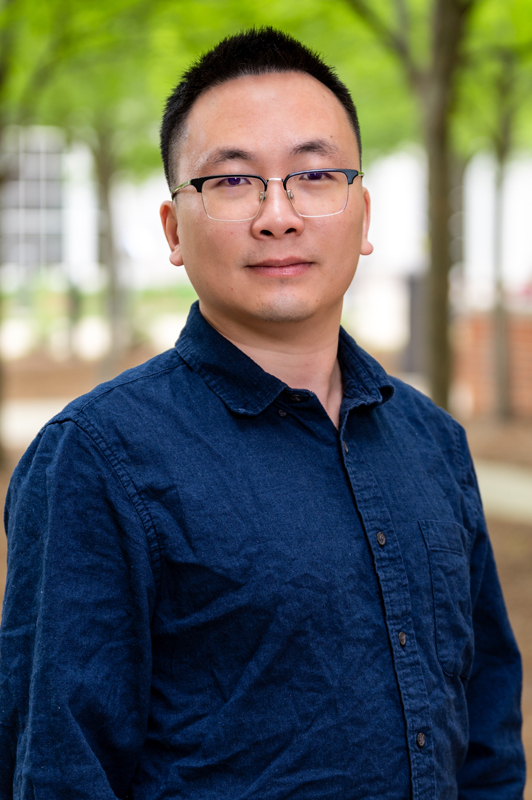
 Bosen Lian, assistant professor of electrical engineering, is principal investigator on the NSF-funded project, “Collaborative Research: Intentional Stance Learning of Belief Dynamics, Objectives, and Control Policies in Autonomous Agents,” which develops new ways for machines to infer the goals, beliefs and intentions of people, animals and autonomous systems from observation.
Machines can observe behavior, but they do not understand intentions.
Bosen Lian, assistant professor in the Department of Electrical and Computer Engineering, wants to change that.
Lian is principal investigator on a three-year, $440,000 National Science Foundation-funded project, “Collaborative Research: Intentional Stance Learning of Belief Dynamics, Objectives, and Control Policies in Autonomous Agents,” and is developing new ways for machines to infer the goals, beliefs and intentions of people, animals and autonomous systems from observation alone.
It is the first in Alabama through the NSF’s Energy, Power, Control and Learning program.
“We're good at controlling machines we understand from the inside,” said Lian, who directs the college’s Intelligent Learning and Control Lab. “We're not good at working alongside decision-makers when we can't see their inner workings, such as a person, an animal or another robot. Most methods get around that by assuming the agent behaves optimally and that we already know its internal equations. This isn’t the case for real agents. We're building a way to learn what an agent is trying to do purely from what it does.
“Prediction is what makes interaction possible. Once you know what another agent is trying to do, you can act on it, imitate it, collaborate with it or defend against it.”
Lian is developing a framework called Dynamic Deep Predictive-Intentional Stance Learning, or DDP-ISL. Rather than assuming an agent behaves optimally or relying on knowledge of its internal mechanics, the framework will learn an agent's evolving beliefs, goals and decision-making strategies directly from observed behaviors.
This combines machine learning, control theory and neuroscience-inspired principles to continually update its understanding of an agent while maintaining stability and reliability. As the system observes new behaviors, it refines its predictions in real time, enabling it to adapt to changing objectives and conditions.
“It’s builds upon an idea from the philosopher Daniel Dennett,” Lian said. “When you want to predict something complicated, you don't explain it mechanically. You treat it as having goals and beliefs and ask what it would do next.”
Lian said the challenge is turning that concept into mathematics and machine learning.
“We attribute a belief and a goal to an agent, let both change over time, and ask what belief and goal would make the behavior we're seeing sensible,” he said.
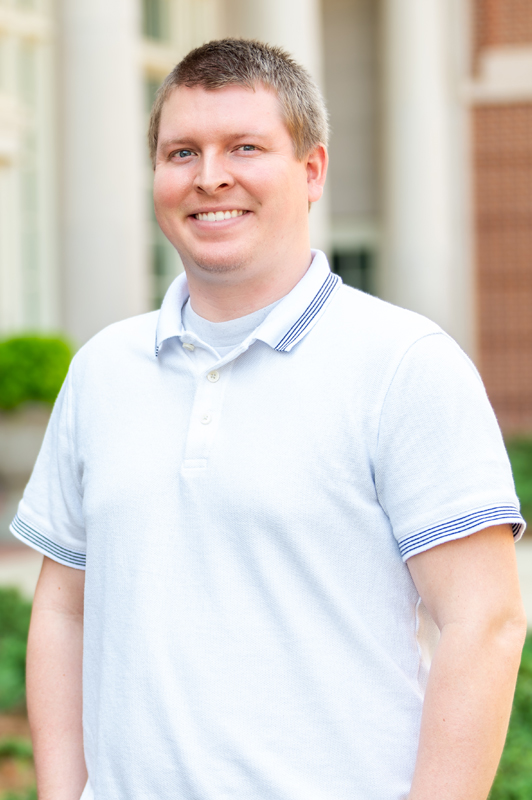
Lian is joined on the project by co-principal investigator Brendon Allen, assistant professor in the Department of Mechanical Engineering and director of the Controls, Autonomy, and Rehabilitation Engineering (CARE) Lab. Here, Allen’s team develops advanced control and learning technologies for autonomous systems and rehabilitation robotics, including exoskeletons designed to improve human mobility and interaction with intelligent machines.
“That's where the two disciplines meet,” Lian said. “For someone with an asymmetric gait, we treat the healthier leg as the agent. The exoskeleton learns what that leg is trying to do, then assists the impaired leg so it mirrors the person's own natural gait, rather than imposing a preset pattern.
“Outside of health, our work can apply anywhere a machine has to read another agent — vehicles predicting drivers and pedestrians, robots on a factory floor, drones coordinating with teammates whose plans they can't see. It's also useful to biologists trying to figure out what an animal is optimizing for from just behavior.”
Media Contact: , jem0040@auburn.edu, 334.844.3447